
Wiring harnesses are used in nearly every electrical system — from automotive dashboards and industrial control cabinets to medical devices and EV battery packs. Because they are so common, many buyers assume they are interchangeable.
But are wiring harnesses truly universal?
The short answer is: Yes — in limited situations. No — in most professional and OEM applications.
For engineers, procurement managers, and OEM buyers, selecting the wrong type of harness can lead to installation delays, compliance failures, signal interference, overheating, or even safety risks.
This guide provides a detailed, technically accurate explanation of:
What universal wiring harnesses really are
When they work — and when they don’t
The engineering differences between standard and custom harnesses
How to decide which solution fits your application
How professional manufacturers support scalable, compliant production
1. What Is a Wiring Harness?
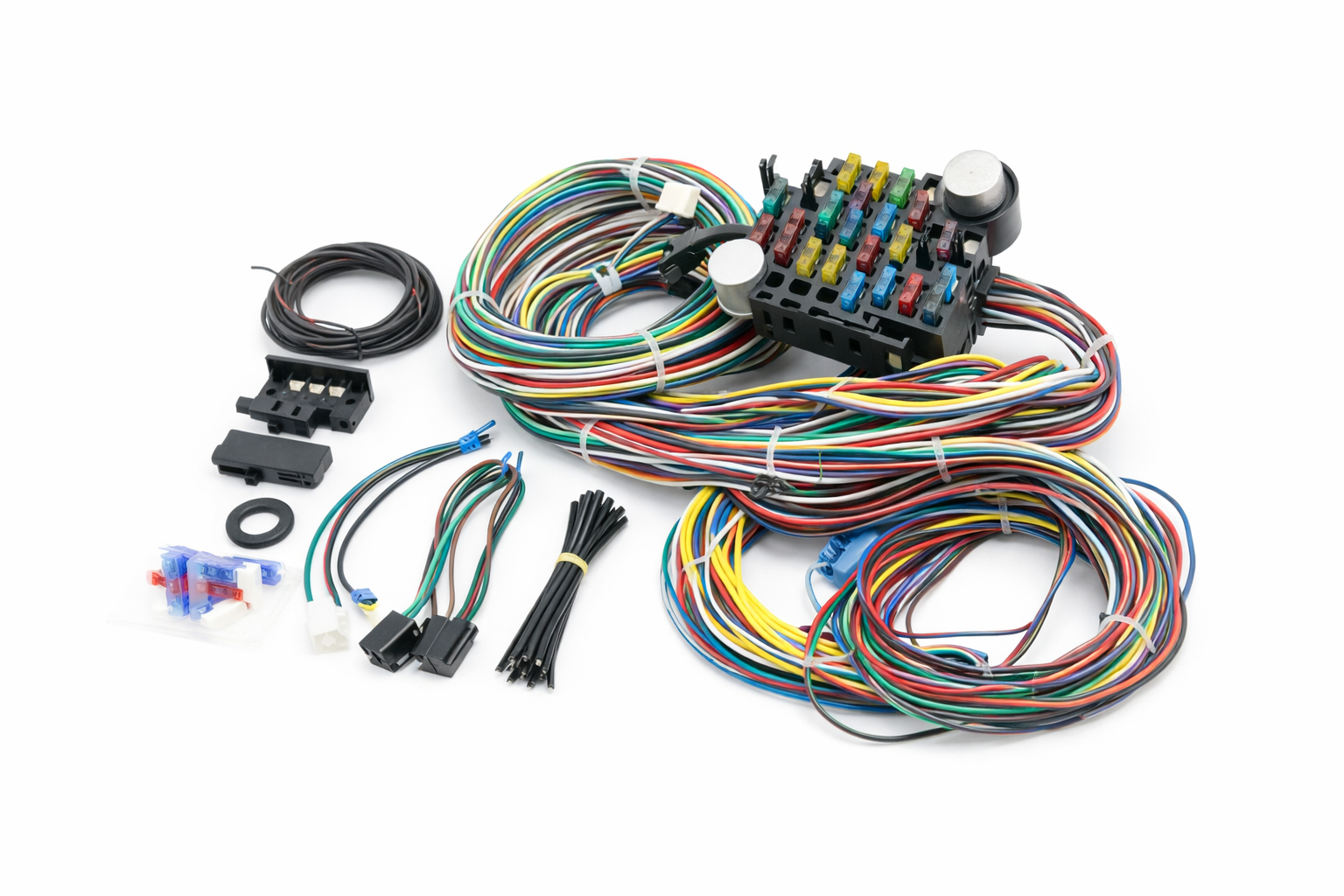
A wiring harness (also called a cable assembly or wire loom) is an organized bundle of wires, terminals, and connectors that transmits electrical power and data signals within a system.
Instead of loose wires running independently, a harness:
Organizes conductors into a defined routing layout
Protects wires from abrasion, heat, vibration, and EMI
Ensures correct signal separation and load capacity
Simplifies installation and maintenance
Core Components of a Wiring Harness
Wires and Cables – Power, signal, shielded, or high-voltage conductors
Terminals and Connectors – Crimped or soldered terminations
Protective Coverings – Braided sleeves, heat shrink, corrugated conduit
Mounting and Management Components – Clips, grommets, breakout points
While the basic structure appears similar across industries, the engineering requirements vary dramatically depending on voltage, current, environment, compliance, and system architecture.
This is why the idea of “universal” compatibility must be carefully examined.
2. What Are Universal Wiring Harnesses?
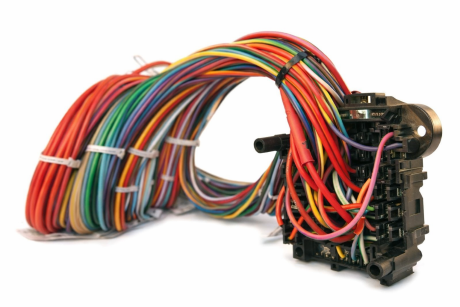
A universal wiring harness is an off-the-shelf electrical harness designed to support a broad range of applications rather than a specific product model.
They typically include:
Long, extra-length wires
Pre-labeled circuits
Generic connector interfaces
Standardized fuse blocks
Basic power distribution layouts
Universal harnesses are most common in:
Automotive restoration projects
Aftermarket audio upgrades
DIY modifications
Temporary repairs
They are intentionally flexible — but flexibility often means compromise.
3. Advantages of Universal Wiring Harnesses
3.1 Cost-Effective
Because universal harnesses are mass-produced:
No custom engineering required
No tooling cost
No prototype validation stage
This reduces the upfront purchase price, making them attractive for low-budget or one-off applications.
3.2 High Availability
Universal harnesses are:
Widely stocked
Sold through distributors and online platforms
Immediately deployable
For urgent repairs, this availability can be valuable.
3.3 Suitable for Non-Critical Systems
For non-safety-critical, low-voltage applications — such as auxiliary lighting or audio systems — universal harnesses can perform adequately when properly installed.
4. Limitations and Risks of Universal Wiring Harnesses
While cost and availability are appealing, universal harnesses introduce significant technical limitations.
4.1 Compatibility Challenges
Modern systems are not simple.
Automotive and industrial platforms often include:
ECU communication networks
CAN bus architecture
ADAS sensor arrays
Shielded signal lines
High-voltage modules
A universal harness cannot be engineered to match:
Exact connector geometry
Pin configuration
Load calculation
Signal isolation requirements
Installers frequently must:
Cut wires
Splice conductors
Replace connectors
Each modification increases resistance and potential failure points.
4.2 Safety and Compliance Risks
In regulated environments (automotive OEM, medical devices, aerospace, industrial automation), wiring must comply with:
UL standards
IPC/WHMA-A-620 workmanship requirements
Automotive OEM validation protocols
Voltage and insulation class standards
Universal harnesses are rarely validated for specific compliance conditions.
For mission-critical systems, this presents unacceptable risk.
4.3 Increased Installation Time
Although universal harnesses are readily available, installation often requires:
Circuit tracing
Connector adaptation
Length trimming
Re-termination
Functional testing
The labor cost can exceed the savings of buying a cheaper harness.
4.4 Reliability Concerns
In vibration-heavy or high-temperature environments:
Poorly matched insulation can degrade
Improper crimping can loosen
EMI shielding may be insufficient
These factors directly affect long-term reliability.
5. Which Industries Commonly Use Universal Harnesses?
Automotive Aftermarket
Classic car rewiring
Audio system integration
Custom builds
DIY and Hobby Applications
Low-voltage electronics
Personal modification projects
Limited Industrial Use
In professional OEM environments, universal harnesses are rarely used for production systems. They may be used only during prototyping or temporary testing.
6. When Custom Wiring Harnesses Are Necessary
In most commercial, industrial, and export-focused applications, custom wiring harnesses are not optional — they are required.
6.1 Complex Electronic Architectures
Systems involving:
Engine Control Units (ECUs)
Advanced Driver Assistance Systems (ADAS)
Industrial PLC networks
EV battery management systems
Require:
Precise pin mapping
Signal shielding
Voltage-rated insulation
Controlled breakout positions
6.2 Harsh Operating Environments
Applications exposed to:
High vibration
Elevated temperatures
Oil and chemical exposure
Outdoor weather conditions
Require material selection tailored to those stresses.
6.3 Regulatory and Certification Requirements
For products exported to the US and EU markets, compliance documentation is often mandatory.
Custom harnesses can be designed to meet:
UL requirements
RoHS compliance
Automotive OEM specs
High-voltage testing standards
7. What Can Be Customized in a Wiring Harness?
A professional custom harness manufacturer can tailor every aspect:
7.1 Wires and Cables
GPT, GXL, SXL automotive wires
High-voltage EV cables
Shielded twisted pair cables
40 AWG to 4/0 AWG sizing
PVC, Teflon, Silicone, PE insulation
7.2 Terminals and Connectors
OEM-specific connectors
Crimped, soldered, or IDC terminations
Gold or nickel plating
Waterproof IP-rated connectors
7.3 Protection Systems
Braided sleeves
Heat shrink tubing
Corrugated conduit
Custom taping positions
7.4 Harness Architecture
Exact breakout positions
Controlled wire length tolerance
Mounting clips and grommets
Defined routing paths
7.5 Testing and Validation
Professional manufacturers conduct:
Continuity testing
Insulation resistance testing
High-voltage dielectric testing
Functional circuit testing
Mechanical and environmental validation
100% automated electrical testing
This ensures plug-and-play integration without field modification.
8. Standard vs Custom Wiring Harness: Direct Comparison
| Feature | Universal Harness | Custom Harness |
| Compatibility | Broad but limited | Application-specific |
| Installation | Requires modification | Plug-and-play |
| Compliance | Not guaranteed | Engineered for standards |
| Reliability | Moderate | High |
| Lead Time | Immediate | Engineering-dependent |
| Lifecycle Cost | Potentially high | Lower long-term |
9. Total Cost of Ownership: The Hidden Factor
When evaluating wiring harness solutions, buyers should consider:
Installation labor cost
Downtime risk
Failure rates
Warranty claims
Field repair cost
Brand reputation impact
In many OEM environments, a custom harness reduces long-term operational risk and overall lifecycle cost.
10. How to Decide: Universal or Custom?
Choose Universal If:
The project is temporary
The system is low-voltage and non-critical
Budget constraints are severe
No certification is required
Choose Custom If:
The system is mission-critical
Compliance is required
Production scaling is planned
Reliability and brand reputation matter
11. Supporting OEM and Export Applications
For companies serving US and European markets, professional harness manufacturing should include:
Engineering consultation
Sample prototyping
Automated crimping processes
Harness board assembly
100% electrical testing
Documentation for export compliance
Stable supply chain for long-term production
An experienced manufacturer supports both small-batch prototypes and scalable OEM production.
Final Answer: Are Wiring Harnesses Universal?
They can be — but only in limited, non-critical situations.
In professional applications where reliability, compliance, and performance matter, wiring harnesses must be engineered specifically for the system they serve.
For OEM buyers, industrial manufacturers, and exporters, a custom wiring harness is typically the safer, more reliable, and more cost-effective long-term solution.
FAQs
- Are universal wiring harnesses safe?
They can be safe in low-risk applications but are not ideal for mission-critical or regulated systems. - Can universal harnesses be modified?
Yes, but each modification introduces potential failure points. - What industries require custom wiring harnesses?
Automotive OEM, EV systems, industrial automation, medical devices, aerospace, and high-voltage equipment. - How long does custom harness production take?
Depending on complexity, prototype lead time typically ranges from 1–4 weeks. - Is a custom wiring harness more expensive?
Upfront cost may be higher, but total lifecycle cost is often lower due to improved reliability.
If you are developing a new product, upgrading an electrical system, or sourcing wiring harnesses for export markets, selecting the correct harness architecture at the design stage prevents costly rework later.
For technical consultation or RFQ support, provide:
Drawings or schematics
Electrical load requirements
Connector specifications
Target market compliance standards
A well-engineered harness is not just wiring — it is the backbone of system reliability.