

The gauge of an electrical wire is arguably its most critical specification. It dictates the wire’s thickness, which in turn determines how much electrical current it can safely carry without overheating. Ignoring this rating is a significant risk: exceeding a wire’s current carrying capacity causes excessive heat generation, leading to the deterioration of the wire and its insulation, which can ultimately result in an electrical fire.
Therefore, knowing how to tell what gauge wire is is a fundamental skill for electricians, technicians, and DIY enthusiasts alike. This guide explores the two most reliable methods for determining wire gauge: using a dedicated tool for solid wire and calculating the cross-section for stranded wire.
I. Gauging Round Solid Wire With a Wire Stripper/Gauging Tool
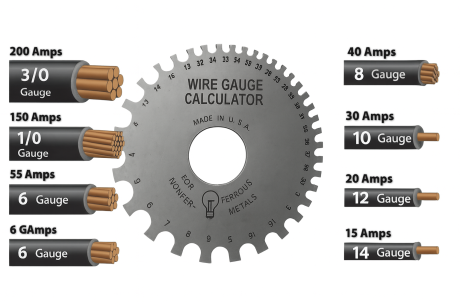
The simplest and most direct way to determine the gauge of a round solid wire is by using a physical gauging instrument.
Tools Required: Wire Gauging Tool or Wire Stripper
A Wire Gauging Tool (sometimes called a Wire Gauge Card or Plate) is typically a rectangular or circular piece of durable metal or plastic. It features a series of precise holes, slots, or notches around its perimeter. Each opening is clearly labeled with a corresponding gauge size.
Before purchasing, ensure your gauging tool specifies the measurement system you require.
AWG (American Wire Gauge): The standard scale used in North America for solid, non-ferrous wire.
SWG (Standard Wire Gauge) or BWG (British Wire Gauge): Older standards, primarily used in British or historic applications.
The Measurement Procedure
Estimate the Approximate Size: Before attempting to insert the wire, visually estimate its diameter. This initial assessment saves time by helping you quickly find a starting point among the numerous holes on the gauge plate, preventing the hassle of trying excessively large or small openings.
Slide the Wire into the Approximate Gauges: Begin inserting the stripped end of the wire into the holes you estimated. Work your way sequentially through the gauges, seeking the perfect fit.
Find the Perfect Fit: The correct gauge size corresponds to the smallest hole the wire can pass through with a tight, yet smooth, fit. The fit should be snug enough that there is no noticeable play, but not so tight that the wire must be forced or shaved down to enter.
Important Note on Hole Design: Be aware that many gauging tools include a slightly larger, unnumbered hole adjacent to the numbered gauging slot. These larger openings are often there simply to allow you to easily remove the wire once the correct gauge has been determined. Do not use these larger holes to determine the gauge size.
Comparative Method (If a Tool is Unavailable): If you lack a gauging tool, you can attempt to determine the gauge by comparing your unknown wire to a known reference. If you suspect your wire is small, compare it visually or manually (by feel) to wires of known gauges (e.g., 22 AWG, 20 AWG, 18 AWG) often found at hardware stores.
II. Gauging Stranded Wire By Measuring Cross-section (The CMA Method)

Stranded wire consists of numerous thin wire strands twisted together to increase flexibility and fatigue resistance. Since its overall diameter includes air space, a direct measurement using a gauging plate is inaccurate. Instead, you must calculate its cross-sectional area using a scale called Circular Mils (CMA).
The Calculation Procedure
Measure the Diameter of a Single Strand:
Separate a single strand from the bundle.
Measure the diameter of this single wire strand precisely. For wires with very small diameters (large gauges), a highly accurate measurement tool like a micrometer or a specialized wire and conduit measuring device should be used, rather than a standard ruler.
Convert the diameter to mils. One mil equals 0.001 inch. (e.g., if the diameter is 0.005 inches, it is 5 mils).
Count the Individual Strands: Carefully count the total number of individual thin strands twisted together to form the complete wire bundle.
Note: Smaller gauge wires (large diameter) may contain 30, 40, or even 100 strands, while very large gauge wires (small diameter) may have only 7 or 8 strands.
Calculate the CMA (Circular Mils): The CMA value represents the circular area of the wire and is calculated using the following formula:
CMA = (Diameter of single strand in mils)² X Number of strands
Example: If the diameter of a single strand is 5 mils (0.005 inches) and the stranded wire has 20 strands:
CMA = (5)² X 20 = 25 X 20 = 500
The result, 500 in this example, is the CMA value for the stranded wire.
Determine the Corresponding AWG Size:
Once the CMA is calculated, consult an AWG reference table (such as the one provided below) or check online resources to find the AWG size that most closely matches your calculated CMA value.
Following the example above: A CMA of 500 would correspond most closely to 22 AWG (640.07 CMA) or 24 AWG (403.99 CMA), allowing you to interpolate or choose the closest standard size.
III. Wire Gauge Reference Table (AWG)
This table provides a cross-reference for common wire gauges and related industry standards:
| AWG | Diameter (MM) | Diameter (Inches) | SWG | BWG | Circular Mils |
| 36 AWG | 0.127000 | 0.005000 | 39 | 35 | 24.999282 |
| 30 AWG | 0.254000 | 0.010000 | 33 | 31 | 99.997128 |
| 24 AWG | 0.510540 | 0.020100 | 25 | 25 | 403.998397 |
| 22 AWG | 0.642620 | 0.025300 | 23 | 23 | 640.071617 |
| 18 AWG | 1.023620 | 0.040300 | 19 | 20 | 1624.043356 |
| 14 AWG | 1.628140 | 0.064100 | 16 | 16 | 4108.691995 |
| 10 AWG | 2.588260 | 0.101900 | 12 | 12 | 10383.311783 |
| 4 AWG | 5.181600 | 0.204000 | 5 | 6 | 41614.804788 |
| 2/0 AWG | 9.265920 | 0.364800 | 2/0 | 2/0 | 167767.341584 |
| 4/0 AWG | 11.684000 | 0.460000 | 4/0 | 4/0 | 266764.588301 |
SWG – Sterling or Standard Wire Gauge
BWG – British Wire Gauge (an older system)
Conclusion
Determining the correct wire gauge is not merely a technicality; it is a critical safety measure. Whether you rely on the precision of a physical wire gauging tool for solid conductors or utilize the CMA calculation for flexible stranded wires, minimal equipment is required to perform these measurements reliably. Always ensure you select high-quality wire of the correct gauge to meet the functional and safety requirements of your electrical system.
FAQs
1. What is the relationship between the AWG number and the wire’s diameter?
The AWG (American Wire Gauge) system uses an inverse proportional relationship: The smaller the gauge number, the larger the wire’s diameter, and the higher the current it can safely carry.
Example: A 10 AWG wire is significantly thicker than a 22 AWG wire, meaning the 10 AWG can safely handle a much greater current load.
2. Why can’t I just measure the outside diameter of stranded wire and use the AWG chart?
Stranded wire consists of multiple thin strands twisted together, meaning its overall outer diameter includes air gaps. If you measure the outside diameter, the size will be much larger than the actual copper metal cross-section.
Wire gauge is determined by the actual area of the metal conductor (carrying capacity). Therefore, you must use the CMA (Circular Mils) method to accurately calculate the conductive metal area of the strands.
3. What wire gauge systems are commonly used besides AWG?
Common alternative wire gauge systems include:
SWG (Standard Wire Gauge): A system primarily used in the UK and some Commonwealth countries.
2 (Square Millimeters): The standard recommended by the International Electrotechnical Commission (IEC), which directly measures the cross-sectional area of the wire and is common in Europe and much of Asia.
BWG (British Wire Gauge): An older system that is now largely obsolete.
4. Why does wire overheating create a fire risk?
When the electrical current exceeds the wire’s safety rating, the wire’s internal temperature rises sharply (according to Joule’s Law, P= I²R)
Insulation Deterioration: The sustained high heat causes the plastic or rubber insulation material to soften, melt, or carbonize.
Short Circuit Risk: Once the insulation fails, adjacent wires or the wire’s conductor may touch a grounded object, causing a short circuit. This generates an intense electrical arc and tremendous heat, which is the primary cause of electrical fires.
5. What is the physical significance of CMA (Circular Mils)?
CMA(Circular Mils) is a unit used to measure the cross-sectional area of a wire.
Definition:1 Circular Mil is the area of a circle with a diameter of 1 mil (0.001 inch).
Advantage: It simplifies the calculation of the area of round conductors, especially stranded wires, by avoiding the constant π. The CMA value can then be directly and accurately converted to the corresponding AWG size.
6. When using a Gauging Tool on solid wire, how do I determine the correct “tight but not excessively snug” fit?
The correct fit should meet two criteria:
No Play: The wire should have no perceptible wobble or significant air gap within the slot.
No Forcing: The wire must be able to slide into the hole smoothly without force or scraping. If you have to push or jam the wire, the slot is too small, and you should use the next larger gauge size.
7. How does the number of strands relate to a wire’s flexibility?
For wires of the same AWG size (meaning they have the same current carrying capacity), the higher the number of individual strands, the more flexible the wire is.
High Strand Count: Provides superior flexibility and fatigue resistance, making it ideal for applications that require frequent movement, bending, or routing in tight spaces (e.g., automotive wiring, robotics, or portable equipment).
Low Strand Count/Solid Wire: Is stiffer and less flexible, but often less expensive and suitable for permanent, fixed installations (e.g., in-wall house wiring).