
Wires and cables act as the nervous system and circulatory system for every electrical setup, from the smartphone in your pocket to the massive HVAC units on commercial rooftops. They are fundamental to functionality, but more importantly, they are critical for safety.
In the world of wiring, size matters—but not in the way one might intuitively think. Selecting the wrong wire thickness can lead to catastrophic failures, including melted insulation, short circuits, and electrical fires. The “gauge” or diameter of the wire is the single most defining characteristic of a cable.
This guide provides an in-depth look at the American Wire Gauge (AWG) system, explaining the physics behind the numbers, how gauge affects technical specifications, and how to use the AWG Wire Size Chart to ensure your projects are safe and efficient.
What is the American Wire Gauge (AWG)?
American Wire Gauge (AWG), also historically known as the Brown & Sharpe wire gauge, is the standardized logarithmic stepped wire gauge system used predominantly in North America since 1857. It is used to specify the diameter of solid, round, and electrically conductive wire.
The Inverse Relationship
The most confusing aspect for beginners is the system’s inverse nature: as the AWG number increases, the wire diameter decreases.
Small Number (e.g., 4 AWG): Thick, heavy-duty wire.
Large Number (e.g., 40 AWG): Hair-thin, fragile wire.
The scale ranges from 0000 (4/0), the largest standard size, down to 40 AWG, the smallest standard size.
Why is it Backwards?
The logic stems from the wire manufacturing process called “drawing.” To make a wire, a metal rod is pulled (drawn) through a series of dies with decreasing hole sizes to stretch and thin it out.
A Gauge 1 wire might have been drawn through a die only once.
A Gauge 30 wire had to be drawn through 30 progressively smaller dies.
Thus, a higher number indicates more processing steps and a thinner final result.
Note: The AWG measurement refers strictly to the metal conductor itself, excluding the wire’s insulation or jacket.
Importance of American Wire Gauge
Selecting the correct AWG is a balancing act between physics, safety, and cost.
1. Electrical Resistance and Conductivity
Think of electricity flowing through a wire like water flowing through a pipe. A wider pipe (lower AWG) allows water to flow freely with little pressure loss. A narrow pipe (higher AWG) restricts flow.
Lower AWG (Thicker): Lower electrical resistance, allowing for higher current flow without significant voltage drop.
Higher AWG (Thinner): Higher electrical resistance.
2. Safety and Heat Management
Resistance generates heat. If you try to push a high current (Amperage) through a wire that is too thin (High AWG), the resistance will cause the wire to heat up rapidly.
If this heat exceeds the insulation’s temperature rating, the insulation will melt, leading to arcing and potential fires. Correct AWG selection is the primary defense against electrical fires.
Cost Efficiency
Thicker wires require more raw copper or aluminum, making them significantly more expensive. Using a 4/0 AWG cable for a simple door bell is technically safe, but financially wasteful. Engineering is about finding the gauge that is safe and effective without being overkill.
Signal vs. Power
Power Transmission: AWG is critical because ampacity (current handling) is the priority.
Signal Transmission (Audio/Video): AWG is less critical because these signals carry very low power. For data cables (like Ethernet or HDMI), factors like shielding and twist rates are more important than the raw thickness of the wire.
Relationship Between AWG Thickness and Technical Specs
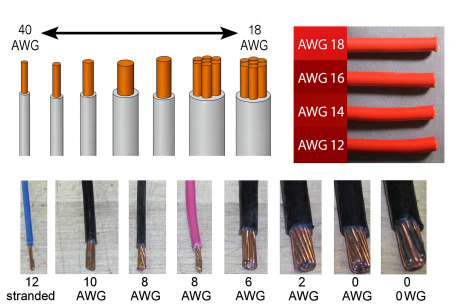
The AWG system is not arbitrary; it is based on precise mathematical formulas.
AWG to Diameter
The relationship between sizes is logarithmic. The ratio of diameter between the largest size (0000 AWG = 0.46 inches and the smallest (36 AWG = 0.005 inches) is 1:92.
There are 39 gauge steps between these two benchmarks. This means each step represents a change in diameter of approximately 1.12 times. The formula to calculate the diameter (D) in inches for any given AWG is:
(Note: For sizes 00, 000, and 0000, use -1, -2, and -3 respectively in the formula).
Rules of Thumb:
Diameter Doubles: Every time you decrease the gauge by 6 (e.g., from 10 AWG to 4 AWG), the wire diameter roughly doubles.
Area Doubles: Every time you decrease the gauge by 3, the cross-sectional area doubles.
AWG to Cross-Sectional Area
While diameter is useful for physical fit, the cross-sectional area (Area= πr²) is what actually determines electrical performance. In the metric system, wires are simply sold by area (e.g., 4 mm² wire). In the AWG system, you must convert.
Important: In the metric gauge system, a higher number equals a larger wire (50 gauge = 5 mm), which is the opposite of AWG. Always verify which standard you are using.
AWG to Load Current Carrying Capacity (Ampacity)
Ampacity is the maximum current a wire can carry before deteriorating. While a thicker wire handles more current, “Ampacity” is not a fixed number; it is a variable dependent on:
Insulation Rating: A wire with insulation rated for 90℃ can handle more current than one rated for 60℃.
Ambient Temperature: Hotter environments reduce a wire’s ability to dissipate heat.
Conductor Material: Copper is a better conductor than aluminum.
The Aluminum Rule: Aluminum has about 61% of the conductivity of copper. A general rule of thumb is that aluminum wire must be 2 AWG sizes larger than copper to carry the same current. (e.g., An 8 AWGaluminum wire carries roughly the same current as a 10 AWG copper wire).
Skin Effect (High Frequency)
In AC circuits, especially at high frequencies, electricity tends to travel along the outer surface (“skin”) of the wire rather than through the center. This effectively reduces the usable cross-sectional area. The Skin Depth Chart is used by engineers to determine the maximum efficient wire diameter for a specific frequency.
AWG for Stranded Wires
The AWG system was originally designed for solid, single-conductor wire. However, many applications require stranded wire (multiple small wires twisted together) for flexibility.
How Stranded AWG is Calculated:
A stranded wire’s AWG is determined by the sum of the cross-sectional areas of all individual strands, not the overall diameter of the bundle. Because there are air gaps between strands, a stranded 10 AWG wire will have a slightly larger physical diameter than a solid 10 AWG wire, even though they contain the same amount of copper.
Naming Convention:
Stranded wires are often specified with three numbers:
23 AWG 5/30
This translates to:
23 AWG: The total effective gauge of the combined wire.
5: The number of strands.
30: The AWG size of each individual strand.
Applications for Different AWG Diameters
Choosing the right wire is critical for appliance performance and fire safety. Below is a guide to common applications for various copper wire gauges:
| AWG Size | Classification | Common Applications |
| 4 AWG | Extra Heavy Duty | Large electric furnaces, central heaters, huge residential service entrance feeds. |
| 6 AWG | Heavy Duty | Electric ranges (stoves), central air conditioning units, electric clothes dryers. |
| 10 AWG | Medium-Heavy Duty | Water heaters, large window AC units, dryers. |
| 12 AWG | Medium Duty | Standard residential outlets (20 Amp circuits), small AC units, kitchen appliances. |
| 14 AWG | Standard Duty | Lighting circuits, standard residential outlets (15 Amp circuits), charging cables. |
| 16 AWG | Light Duty | Light-duty extension cords, lamps, portable work lights. |
| 18 AWG | Very Light Duty | Low-voltage lighting (LED strips), lamp cords, thermostat wiring. |
Conclusion
Understanding the AWG Wire Size Chart is not just about memorizing numbers; it is about ensuring the safety and longevity of your electrical systems. Whether you are wiring a house or building a custom cable assembly, remembering that “Lower Gauge = Thicker Wire = Higher Current” is the golden rule.
Using a wire that is too thin invites overheating and failure, while using a wire that is too thick wastes budget and space.
If you are unsure about the specific requirements for your project—especially regarding complex harness assemblies or high-temperature environments—do not guess. Contact Grace. As a leading manufacturer of superior quality cable assemblies, we can guide you to the precise custom solution your project requires.
FAQs
1. Is a higher AWG number a thicker wire?
No, it is the opposite. The AWG system works on an inverse scale. A higher number (like 24 AWG) indicates a thinner wire, while a lower number (like 4 AWG) indicates a thicker wire. Think of the number as the number of times the wire was “drawn” or stretched during manufacturing; more stretching equals a thinner wire.
2. Does the length of the wire affect the AWG I should choose?
Yes, absolutely. All wires have internal resistance. Over long distances, this resistance causes voltage drop, which can make your appliances run poorly or overheat the motor. If you are running a wire over a long distance (typically over 50-100 feet), you often need to “upsize” to a thicker wire (a lower gauge number) to compensate for this drop.
3. Can I use solid and stranded wire interchangeably if they are the same AWG?
In terms of electrical current capacity, yes—a 12 AWG solid wire carries the same current as a 12 AWG stranded wire. However, their physical applications differ. Solid wire is rigid and best for permanent infrastructure (like house wiring inside walls). Stranded wire is flexible and durable against bending, making it ideal for extension cords, car wiring, and electronic devices that move.
4. What is the difference between AWG and SWG?
AWG stands for American Wire Gauge, while SWG stands for Standard Wire Gauge (the British standard). They are not the same. A 12 AWG wire and a 12 SWG wire have different diameters. Always verify which standard your equipment requires, as using the wrong one can lead to fitting issues or electrical hazards.
5. How do I measure the gauge of a wire I already have?
You can use a specialized Wire Gauge Tool (a circular tool with cutout slots). Important: Do not measure the insulation. You must strip the wire and insert only the metal conductor into the slots. The slot that fits the wire snugly (without forcing it) indicates the gauge. Alternatively, you can use a digital caliper to measure the diameter and compare it to the chart in this article.
6. Why do some charts list different amp ratings for the same gauge?
The “Ampacity” of a wire depends heavily on the temperature rating of its insulation (60℃, 75℃, or 90℃). A 12 AWG wire with high-temperature insulation can safely handle more current than a 12 AWG wire with standard insulation because the insulation won’t melt as easily. Always check the temperature rating printed on the cable jacket.
7. Does the AWG size include the plastic insulation?
No. The American Wire Gauge standard refers strictly to the diameter of the metal conductor (copper or aluminum) inside. The thickness of the plastic insulation (jacket) varies depending on the voltage rating and durability requirements, but it does not count towards the AWG size.