
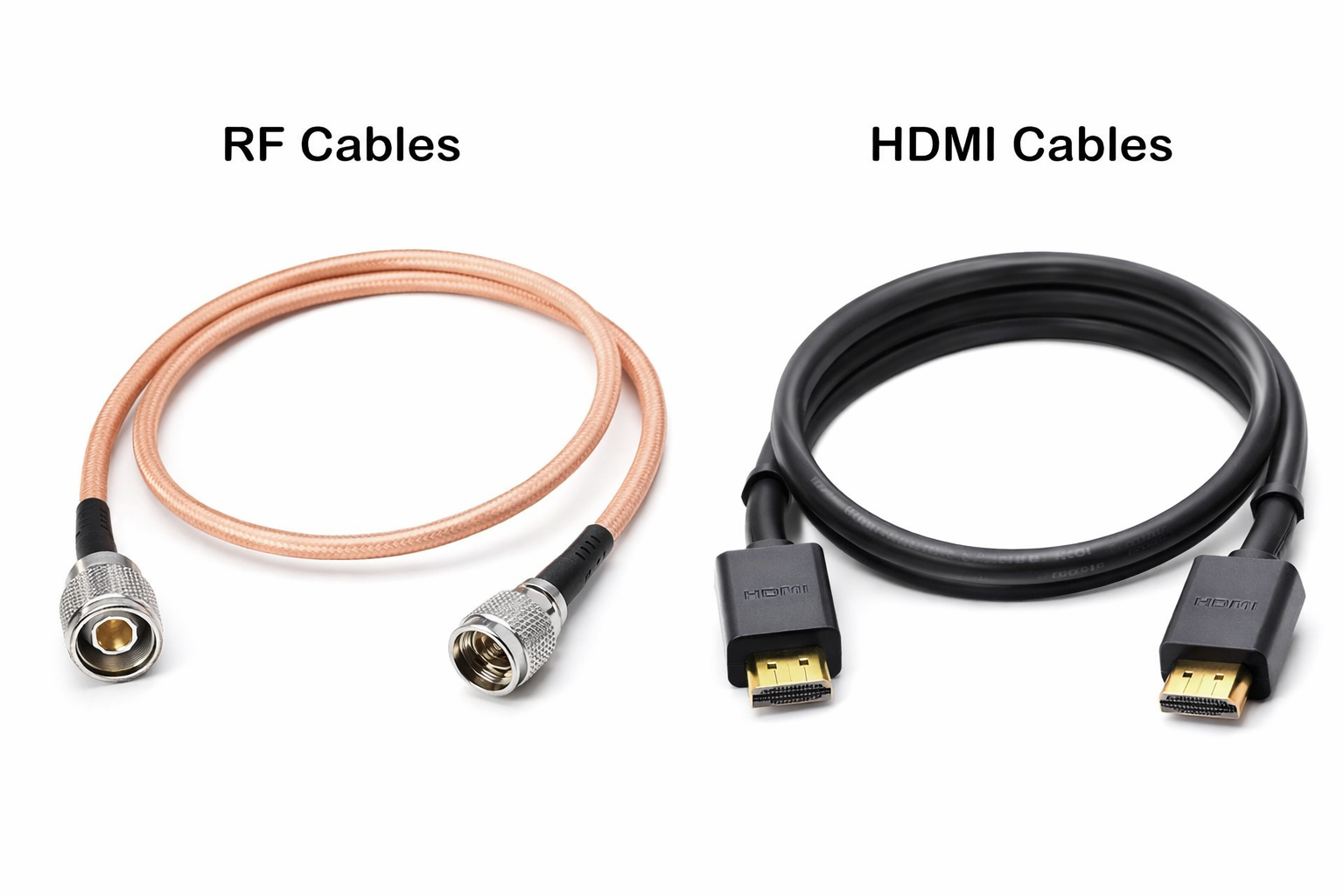
Selecting the correct cable is a critical decision in any signal transmission system, whether you are working with legacy broadcast equipment, industrial communication systems, or modern home entertainment setups. Among the most commonly compared cable types are RF (Radio Frequency) cables and HDMI (High-Definition Multimedia Interface) cables.
Although both are used to transmit audio and video signals, they are fundamentally different in design, performance, and intended applications. RF cables are deeply rooted in analog and radio-frequency communication, while HDMI cables dominate today’s digital audio-visual landscape.
This article provides a detailed technical comparison of RF and HDMI cables, explaining how they work, where they excel, where they fall short, and how to determine which solution best suits your specific requirements.
What Are RF and HDMI Cables?
RF Cables
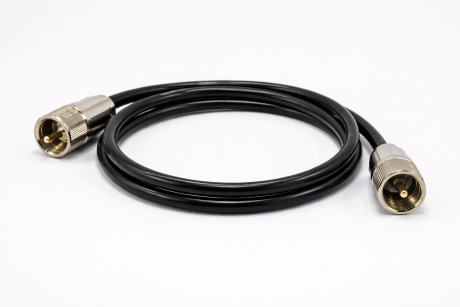
RF cables, most commonly referred to as coaxial cables, are designed to transmit radio-frequency signals over short to very long distances. Their construction typically includes a central conductor, a dielectric insulator, a metallic shield (braid or foil), and an outer protective jacket. This layered structure is engineered to minimize signal loss and electromagnetic interference.
RF cables are optimized for analog signal transmission, though they can also carry modulated digital data in certain applications. Their ability to maintain signal integrity over long distances makes them indispensable in environments where reliability and robustness are critical.
Common RF cable applications include:
Television antenna and cable TV systems
Satellite communications
Broadcast and transmission infrastructure
Aviation, military, and industrial radio systems
High-performance RF cables, such as low-loss coaxial lines, are engineered to handle specific frequency ranges with predictable attenuation characteristics, making them ideal for mission-critical communication systems.
HDMI Cables
HDMI cables were introduced in the early 2000s to simplify audio and video connections by combining both signals into a single digital interface. Unlike RF cables, HDMI transmits uncompressed digital data, ensuring high fidelity and precise signal reproduction.
Modern HDMI standards have evolved rapidly. HDMI 2.0 supports 4K resolution, while HDMI 2.1 offers bandwidth up to 48 Gbps, enabling 8K video, high refresh rates, HDR, variable refresh rate (VRR), and advanced audio formats.
Typical HDMI cable applications include:
Televisions and computer monitors
Gaming consoles and graphics cards
Blu-ray players and streaming devices
Home theater and professional AV systems
HDMI has become the universal standard for consumer and professional digital video transmission due to its simplicity, performance, and broad device compatibility.
Key Differences Between RF and HDMI Cables
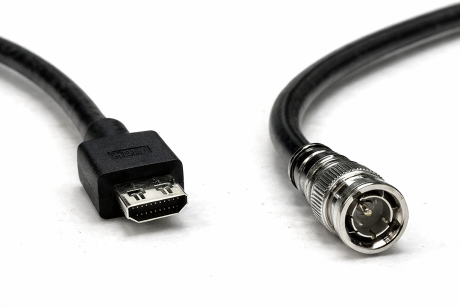
Signal Type
The most fundamental difference lies in signal transmission. RF cables primarily carry analog signals, which vary continuously and are susceptible to degradation over distance. HDMI cables transmit digital signals, where data is encoded as binary information, allowing for precise reproduction as long as signal integrity is maintained.
Audio and Video Capabilities
RF cables typically support lower-resolution analog video and basic audio transmission. While sufficient for legacy systems, they cannot meet modern high-definition requirements.
HDMI cables support:
4K and 8K video resolutions
HDR and wide color gamuts
Advanced audio formats such as Dolby Atmos and DTS-HD
This makes HDMI the clear choice for high-quality multimedia applications.
Bandwidth and Data Capacity
RF cable bandwidth depends on frequency range and cable design, usually operating effectively between tens and hundreds of megahertz. Data throughput is inherently limited by analog modulation.
HDMI bandwidth is orders of magnitude higher. HDMI 2.1’s 48 Gbps capacity enables ultra-high-definition video and low-latency features essential for gaming and immersive media.
Interference and Signal Integrity
RF cables rely on shielding to protect against electromagnetic interference. Over long distances, however, analog signals gradually degrade due to attenuation and noise.
HDMI’s digital transmission ensures near-perfect signal reproduction over short to moderate distances. When signal quality drops below a threshold, errors occur abruptly rather than gradually degrading image quality.
Durability and Physical Design
RF cables are often designed for harsh environments, with thick jackets, armored constructions, and weather resistance. They are suitable for outdoor, industrial, and aerospace use.
HDMI cables prioritize flexibility, ease of installation, and compact connectors. While premium HDMI cables offer shielding and reinforced connectors, they are generally less rugged than industrial RF cables.
Cost and Installation Considerations
RF cables are often more cost-effective for long-distance and infrastructure-heavy installations. They are also easier to customize and terminate in the field.
HDMI cables can be more expensive, particularly at higher performance levels. However, they reduce system complexity by eliminating the need for separate audio and video cables.
When Should You Choose RF or HDMI?
Choose RF Cable If:
You are working with legacy or analog systems
Long-distance transmission is required
The environment demands rugged, interference-resistant cabling
Applications involve broadcast, aviation, or industrial communications
Choose HDMI Cable If:
You are connecting modern digital devices
High-resolution video and immersive audio are required
Installation simplicity and minimal cabling are priorities
Data integrity over short distances is critical
Real-World Application Examples
In aviation communication systems, RF cables are used to ensure reliable VHF and UHF signal transmission across long cable runs with predictable attenuation. These systems prioritize reliability and environmental resistance over multimedia quality.
In contrast, a home theater system relies on HDMI cables to deliver synchronized high-definition video and multi-channel audio. Without HDMI’s bandwidth and digital precision, modern cinematic experiences would not be possible.
Additional Technical Insights on Audio and Video Transmission
Audio Performance
HDMI supports lossless and object-based audio formats, making it suitable for professional and consumer-grade sound systems. RF cables, while capable of transmitting audio, are limited by analog fidelity and noise susceptibility.
Video Performance
RF video transmission is constrained by analog standards and is unsuitable for modern ultra-high-definition displays. HDMI is specifically designed for scalable digital video performance.
Cost vs. Performance Trade-Offs
RF cables remain a cost-effective solution for long-distance and infrastructure applications. HDMI offers greater value in integrated multimedia systems where performance and simplicity outweigh initial cost.
Conclusion: Which Cable Is Right for You?
There is no universally superior option between RF and HDMI cables. Each serves a distinct purpose:
RF cables excel in durability, long-distance transmission, and industrial reliability.
HDMI cables dominate modern digital audio-visual systems with superior quality and convenience.
The correct choice depends on your application, performance requirements, environment, and system compatibility. By understanding the strengths and limitations of each cable type, you can ensure optimal performance and long-term reliability. Contact us for more information.
FAQs
Q1: What factors determine the signal loss in RF cables over long distances?
A: Signal loss in RF cables is affected by conductor resistance, dielectric properties, shielding effectiveness, frequency, and temperature. Higher frequencies experience greater attenuation due to the skin effect, and poor shielding can allow electromagnetic interference (EMI) to degrade signal integrity.
Q2: How do cable impedance mismatches affect RF signal transmission?
A: Impedance mismatches in RF systems can cause signal reflections, standing waves, and power loss. Maintaining a consistent characteristic impedance (typically 50 Ω for RF coaxial cables) is essential to prevent return loss and ensure maximum signal transfer.
Q3: Can HDMI cables be used reliably over distances longer than 15 meters?
A: Standard passive HDMI cables typically support up to 15 meters without signal degradation. For longer runs, active HDMI cables, fiber-optic HDMI, or signal boosters are recommended to maintain digital integrity and reduce data loss.
Q4: How does shielding in RF and HDMI cables differ in design and effectiveness?
A: RF cables often use multiple layers of shielding (braid + foil) to resist high-frequency interference in harsh environments. HDMI cables generally rely on foil shields and twisted pair design to minimize crosstalk between high-speed differential signal pairs.
Q5: What is the significance of the return loss specification in RF cables?
A: Return loss measures the amount of signal reflected back toward the source due to impedance discontinuities. High return loss (greater dB) indicates minimal reflection and better transmission quality, which is critical in broadcast and high-frequency RF applications.
Q6: How do HDMI standards handle high refresh rates and HDR content?
A: HDMI 2.1 supports bandwidth up to 48 Gbps, enabling 4K at 120Hz or 8K at 60Hz, alongside HDR10+, Dolby Vision, and dynamic metadata. This requires cables and connectors capable of maintaining high signal integrity with minimal attenuation and EMI.
Q7: What environmental factors impact the longevity of RF and HDMI cables?
A: RF cables are susceptible to UV exposure, moisture ingress, temperature extremes, and mechanical stress. HDMI cables are more sensitive to bending radius, connector strain, and electromagnetic interference. Using ruggedized or shielded variants increases durability in harsh conditions.
Q8: Can RF cables carry digital signals effectively?
A: Yes, RF cables can transmit digital signals using modulation schemes (e.g., QAM, OFDM). However, analog RF cable characteristics like attenuation, impedance consistency, and EMI susceptibility limit the maximum data rates compared to HDMI or fiber-optic digital links.
Q9: What are the trade-offs between copper and fiber HDMI or RF cables for long-distance applications?
A: Copper cables are cost-effective but suffer from signal loss and EMI over long distances. Fiber-optic variants eliminate EMI and support much longer runs with minimal attenuation, but they are more expensive and require specialized termination.
Q10: How does cable quality affect video and audio synchronization in HDMI systems?
A: Poor-quality HDMI cables can introduce signal delay, jitter, or frame skipping, particularly in high-resolution or high-frame-rate systems. High-quality cables maintain consistent impedance, shielding, and low capacitance to ensure synchronized video and audio transmission without artifacts.