


The 1/4-inch connector, often referred to as a phone plug or TRS/TS jack, has maintained its status as the ubiquitous standard in professional and semi-professional audio for over a century, dating back to 1878. Originally designed for conveniently switching telephone lines at central stations, its robust design and reliable conductivity quickly cemented its role in the burgeoning audio industry.
Today, this connector, measuring 6.35mm in diameter, is the primary means of transmitting analog audio signals across most professional environments. You will find ¼ ports on virtually all professional audio gear, including:
Electric Guitars and Keyboards: For connecting instruments to amplifiers.
Audio Mixers: For inputs, outputs, sends, and returns.
Amplifiers and Speakers: For interconnecting power stages and cabinets.
Studio Interfaces and Patch Bays: For signal routing and processing.
The 1/4-inch connector is considered the robust, full-size standard, offering a larger contact area and greater durability compared to the smaller 3.5 mm or 1/8-inch) mini-connector prevalent in consumer devices like smartphones and laptops.
Types of 1/4″ Connector: TS vs. TRS
The function of a 1/4″ connector is defined by the number of conductive segments it possesses. These segments are separated by thin insulating rings. The two main types are TS and TRS.
A. 1/4″ TS Connectors (Tip-Sleeve)
The TS connector is the simplest form, featuring only two contact points:
Tip (T): Carries the hot (+) or positive audio signal.
Sleeve (S): Serves as the ground, shield, or cold (-) contact.
Signal Transmission: Unbalanced Mono
TS cables are used exclusively for unbalanced mono audio signals. “Unbalanced” means the signal is referenced only to the ground, making it susceptible to picking up electromagnetic interference (EMI) and radio frequency interference (RFI) over longer cable runs (typically exceeding 15–20 feet).
Primary Applications:
Instrument Cables: Electric guitars, basses, and keyboards that output a single, mono, unbalanced signal.
Speaker Cables: Used to connect power amplifiers to passive speaker cabinets (though these are often thicker gauge).
Short Patch Cables: For connecting effects pedals or components within close range.
B. 1/4″ TRS Connectors (Tip-Ring-Sleeve)
The TRS connector is distinguished by the addition of a third contact point: the Ring.
Tip (T): Carries the primary signal (or the positive/hot (+) wire in a balanced connection).
Ring (R): Carries the secondary signal (or the negative/cold (-) wire in a balanced connection).
Sleeve (S): Serves as the ground or shield.
Signal Transmission: Balanced Mono or Unbalanced Stereo
The versatility of the TRS connector allows for two critical functions:
Balanced Mono Signal: This is the most common professional use. The TRS uses the Tip and Ring to carry the exact same audio signal, but the Ring signal is 180° out of phase (inverted) with the Tip signal. Any noise picked up by the cable is identical on both lines. When the signal reaches the receiving device, the Ring signal is reinverted, cancelling the noise while summing the original signal. This allows for clean, low-noise transmission over long distances.
Unbalanced Stereo Signal: The Tip carries the Left Channel, and the Ring carries the Right Channel, with the Sleeve as the common ground. This is typical for connecting stereo headphones.
Primary Applications:
Headphone Connections: To deliver separate left and right stereo channels.
Studio Monitor Connections: To carry a balanced mono signal from an audio interface to a powered speaker.
Mixer Inserts: To send a signal out to an external processor and return it on the same cable (TRS Insert).
1/4″ Jack Wiring Diagrams
Understanding the wiring conventions is crucial for troubleshooting and selecting the right cable.
A. 1/4″ Mono Plug (TS) Wiring
A simple two-conductor design used for unbalanced, single-channel (mono) transmission.
Tip: Signal (+)
Sleeve: Ground/Shield (-)
B. 1/4″ Stereo Jack (TRS) Wiring
A three-conductor design used for balanced mono or unbalanced stereo transmission.
Tip: Signal 1 (or Hot +)
Ring: Signal 2 (or Cold -)
Sleeve: Ground/Shield
C. Can a 1/4″ Stereo Jack be Wired as Mono?
Yes, a TRS plug can be wired for mono use in two main ways:
Unbalanced Mono Cable: Connect the Tip to the signal wire and solder both the Ring and the Sleeve to the ground/shield. This ensures the output ring of a TRS jack is grounded when the plug is inserted.
Converting Stereo to Mono Signal: In custom cabling, the Tip (Left) and Ring (Right) wires are electrically joined together and connected to the single signal pin of a mono jack, effectively combining the two stereo channels into one mono channel.
How 1/4″ Audio Cables Function in Various Roles

The naming of the plug (TS or TRS) only indicates the number of conductors; the actual function depends entirely on the signal delivered by the source device and expected by the receiver device.
| Plug Type | Application/Signal Type | Tip (T) | Ring (R) | Sleeve (S) |
| TS | Unbalanced Instrument (Guitar) | Hot (+) | N/A | Shield (-) |
| TS | Speaker (Amplifier Output) | Hot (+) | N/A | Cold (-) |
| TRS | Balanced Mono (Pro Audio) | Hot (+) | Cold (-) | Shield (Ground) |
| TRS | Unbalanced Stereo (Headphones) | Left (+) | Right (+) | Shield (-) |
| TRS | Unbalanced Insert (Mixer Insert) | Send (Out) | Return (In) | Shield (-) |
1/4″ TRS Plug as Unbalanced Insert:
This function is common on mixing consoles. The TRS plug splits the signal path: the Tip is the Send (signal goes out to an effects unit), and the Ring is the Return (signal comes back in from the effects unit).
Choosing the Right 1/4″ Jack Wiring
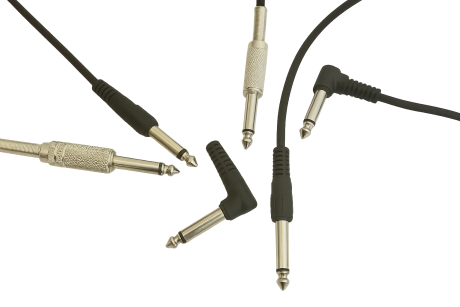
Selecting the correct cable type is critical to prevent noise, phase issues, or signal loss.
| Cable Type | Wiring Configuration & Function | When to Use |
| Microphone Cords: BALANCED | XLR to TRS Jack: Tip to Pin 2 (+Hot), Ring to Pin 3 (-Cold), Sleeve to Pin 1 (Ground/Shield). | Connecting a mixer’s XLR output to an active speaker’s TRS input for noise-free transmission. |
| Microphone Cords: UNBALANCED | XLR to TS Mono: Tip to Pin 2 (+Hot). Sleeve connected to both Pin 1 & Pin 3 (Ground/Cold). | Connecting a balanced XLR device to a simple, unbalanced TS input (sacrificing noise immunity). |
| Jack Cords: BALANCED/STEREO | TRS to TRS: Tip-to-Tip, Ring-to-Ring, Sleeve-to-Sleeve. | Connecting two balanced line-level devices or for use with stereo headphones. |
| Jack Cords: UNBALANCED/MONO | TS to TS: Tip-to-Tip, Sleeve-to-Sleeve. | Connecting instruments, pedals, or non-critical, short-run audio equipment. |
| Adapter Cords: INSERT | TRS to 2 x TS (Tip → TS-1, Ring → TS-2): Splits the Tip (Send) and Ring (Return) signals into two separate mono plugs. | Connecting a mixer’s TRS insert jack to the input/output of a dedicated outboard effects unit. |
FAQs
What is the use of XLR to 1/4″ jack wiring?
XLR to 1/4″ jack cables are used to interface devices with different connector standards while preserving the balanced signal integrity. They are essential for converting a balanced XLR output (common on mixers and microphones) to a balanced 1/4″ TRS input (common on active speakers, audio interfaces, and studio rack gear).
How can you wire an XLR cable to a 1/4 inch jack plug?
For a balanced mono signal, the standard wiring convention (following the AES/EBU standard) is:
1/4 inch TRS Tip → XLR Pin 2 (+Hot)
1/4 inch TRS Ring → XLR Pin 3 (-Cold)
1/4 inch TRS Sleeve → XLR Pin 1 (Ground/Shield)
If wiring an unbalanced XLR to TS, the shield (Pin 1) and the cold signal (Pin 3) must be joined and connected to the 1/4″ TS Sleeve, losing the noise cancellation capability.
What is the advantage of using a 1/4″ plug over a 3.5 mm plug?
The 1/4″ plug offers superior mechanical and electrical advantages, making it the professional standard:
Durability: Its larger size makes it physically more robust and resistant to bending or breakage under foot traffic or frequent patching.
Contact Area: The larger surface area of the contacts ensures a more reliable and stable electrical connection, leading to less intermittent signal loss or crackling.
Cable Strength: 1/4″ connectors are designed to accommodate thicker, more robust professional audio cabling which aids in shielding and noise reduction.
Conclusion
The 1/4-inch connector remains the backbone of the professional audio industry. Its distinction between the two-conductor TS (unbalanced/mono) and the three-conductor TRS (balanced/stereo/insert) is the key to ensuring clear, noise-free signal transmission. Understanding the appropriate wiring configuration—whether for instruments, balanced outputs, or stereo headphones—is essential for optimizing any audio setup. Contact us for more information.